
 Oasis · the brand my client work is delivered under
Moses Ojeleye
Research writer and editor for hire · data and AI specialist under the same roof
Open to remote and hybrid contracts worldwideOasis is my studio: writing, research and design delivered under one brand, run from Abeokuta in Ogun State for clients anywhere. Every chip on this page opens the actual file, and a real task comes back within 48 hours.
The brand film · thirty-four seconds, sound on

Selected work · links open the real files
Three projects, every deliverable behind a link
Each project below is my own work, credited truthfully: I am the author, researcher, editor, designer and producer of record for all three. Ghostwritten client pieces stay confidential by agreement, so nothing on this page carries someone else's byline.
Previews are reduced for speed. The linked masters carry the full stated sizes: 1600 × 2560 retail JPEG, 1706 × 2730 print master at 300 dpi, 1600 × 2400 ebook PNG.
Confidential client work
Most paid writing is ghostwriting and stays confidential by agreement, so this page shows only my own projects. References and contract proof on request.
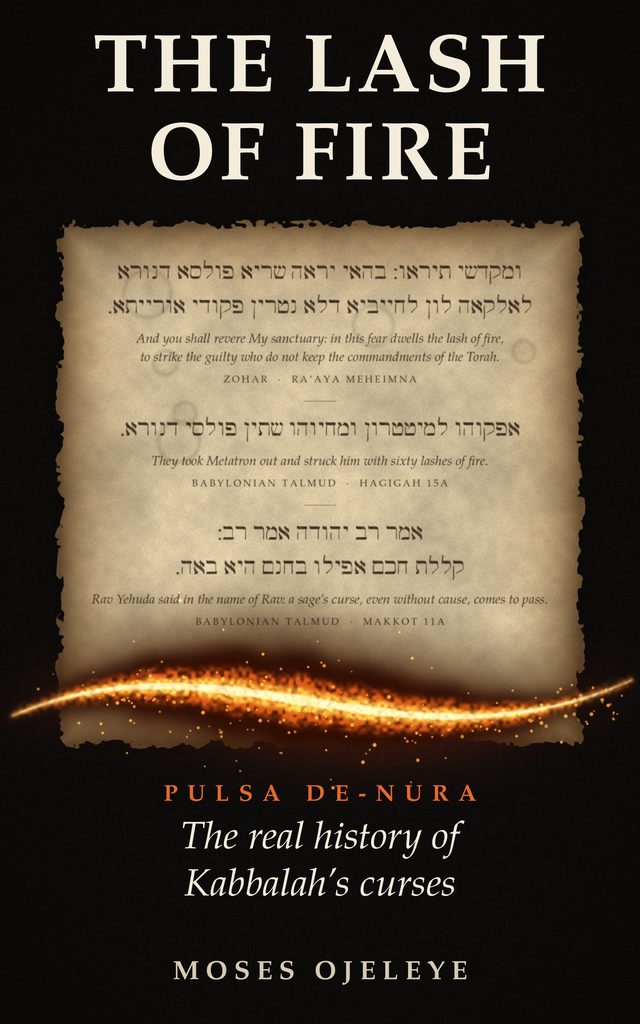
The Lash of Fire
Pulsa de-Nura and the Real History of Kabbalah's Curses · research monograph · first edition, 2026
- 94,800 words, roughly eight hours of reading; Introduction, Prologue, seventeen chapters in four parts, Epilogue; 300+ endnotes carrying page-level citations.
- Companion source ledger recording every claim with its source and its strength: documented, reported, disputed, legend. The tier words appear on the page of the book itself.
- Production set built from one source: print-ready 6 × 9 in PDF (241 pages), A4 large-type reading edition with the same pagination, EPUB with live endnote links, DOCX master.
- Submission engine: proposal with cover letter to a named acquiring editor, sample chapters, one-page summary, author biography, live submissions tracker. Six presses live and one closed , last updated 17 October 2026.
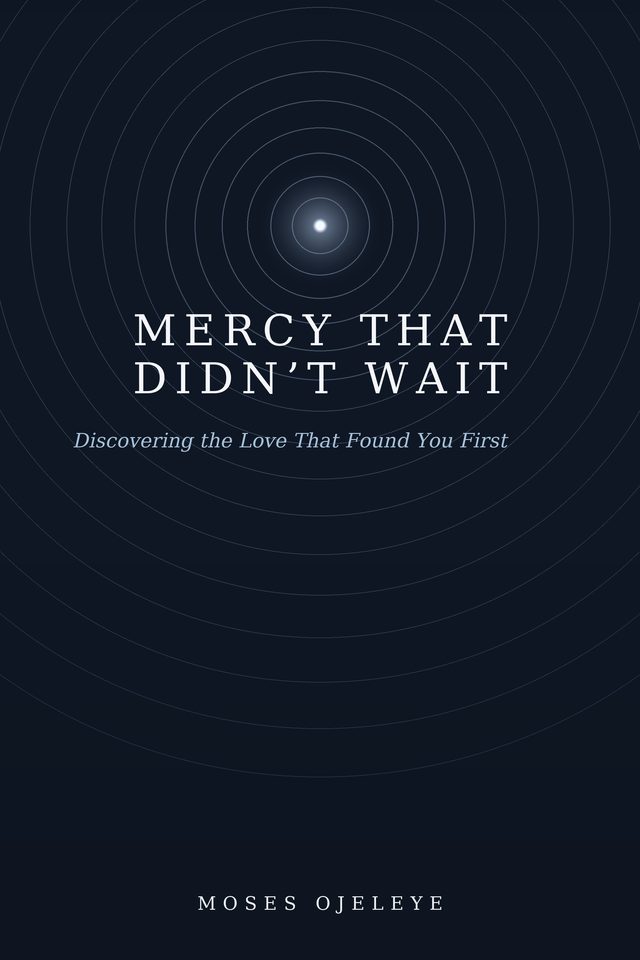
Mercy That Didn't Wait
Discovering the Love That Found You First · memoir and full publishing operation · 2026
- Seventeen short chapters, about 15,900 words, 83 pages. Each chapter holds a story, a hard question answered from Scripture, one small action, three reflection questions and a prayer.
- Production set: 6 × 9 in interior print PDF with spine computed at 0.187 in, EPUB, DOCX master, full cover wrap, audio manuscript prepared for narration.
- Retail and distribution work: bibliographic record, store description, BISAC categories, seven keyword phrases, pricing and royalty guidance with print-cost maths, platform-by-platform upload steps, wide-distribution plan, ARC tracking.
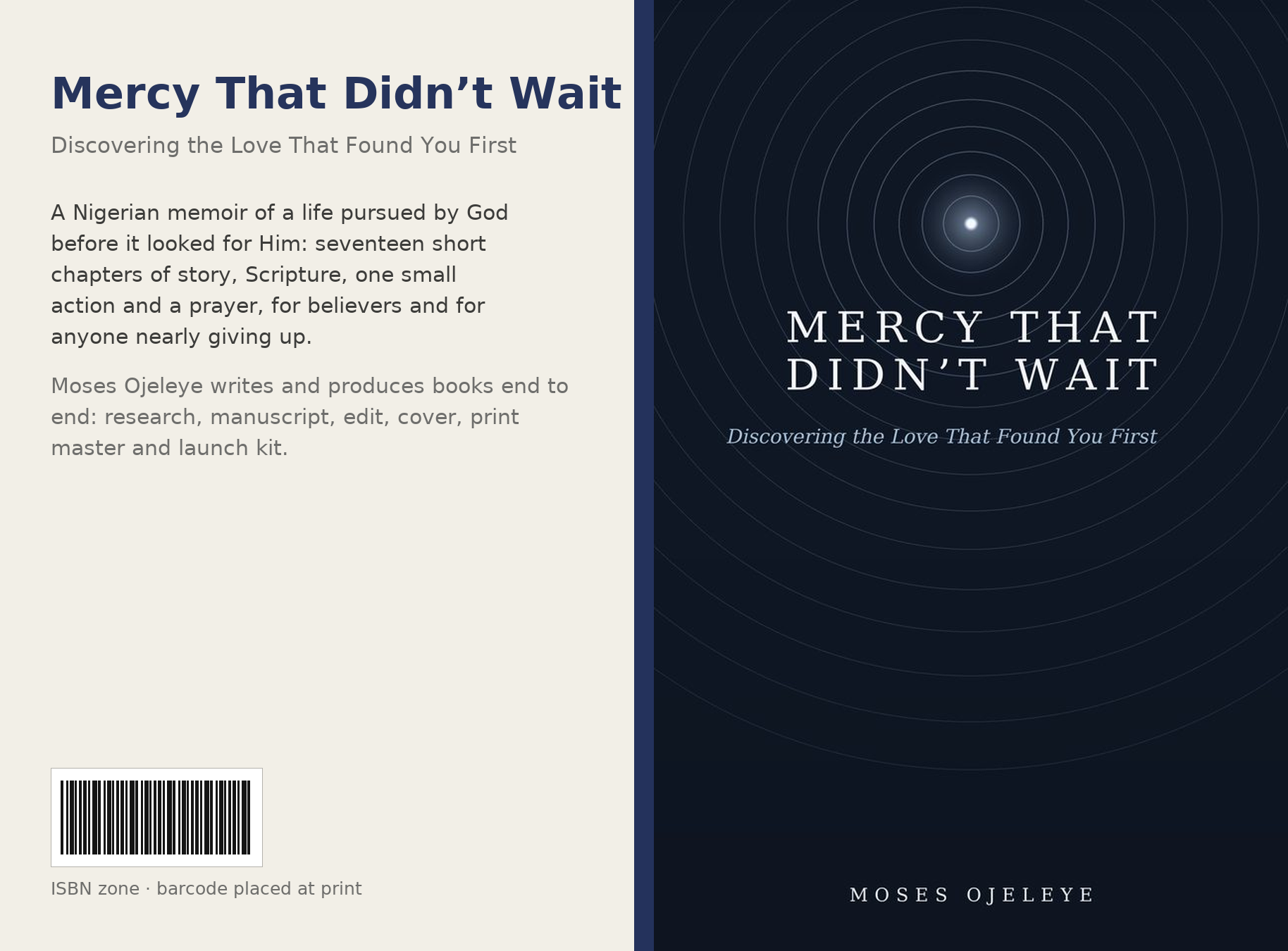
Cover and print production
Design deliverables for both books, built to printer and store specifications
Also available: logo and brand identity, social and print graphics, promotional launch artwork, and landing-page design (layout plus conversion copy). Typography and brand voice are kept consistent across print, ebook and promotional artwork, and cover text is checked letter for letter against the title page.

Oasis: the brand identity
Logo and monogram designed by Moses Ojeleye, September 2026
- Primary logo: a three-stem sprout with gold terminals beside the Oasis wordmark, on a transparent field, so it sits cleanly on light or dark.
- Monogram: the sprout mark alone, still legible at favicon size. It is the favicon of this site.
- Remaining identity pieces, per the design brief: palette with hex codes and use rules, two typefaces with sizes, business card at 300 dpi, a 1080 × 1080 social tile, one page of brand rules, and a landing page mockup built from the copy deck in the spec samples.

Writing samples · verbatim, from my own books and kits
Four registers of my own writing
Scholarly argument, warm memoir, pitch copy and retail copy, each quoted exactly as it stands in the file. Ask for any of these in a different voice and I will write you a sample against your brief before you commit.
Scholarly non-fiction: opening an argument
Ask where the death curse of the Kabbalah comes from, and the answer arrives quickly, with perfect confidence. It is ancient. It was whispered in the academies of Babylon and in the hills of Galilee. It was never written down, because it was far too dangerous to write down, which is precisely why the men who know it keep it in memory, and why the story of a death curse read aloud at midnight in a cemetery feels less like news than like a trapdoor into an older world.
The trouble begins when you look for the book. The historical record of Jewish cursing is not empty. It is full of bowls and amulets and recipes and court rulings, and the chapters ahead will walk through quantities of it. The death curse, by contrast, arrives with nothing. No manual prints it. No medieval manuscript describes the ceremony.
The Lash of Fire, Introduction: The Whisper and the Archive
Proposal writing: the claim, stated flatly
It is not ancient, it is not in the Kabbalah, and almost everything written about it for a general audience is false.
The modern ceremony was assembled in the twentieth century. The Hebrew sources, in the English translations I worked from, say by the Edah HaCharedit in Jerusalem, using a text from a medieval legal compendium, the Kol Bo, and adopting the mystical-sounding name “for the purpose of intimidation.”
The Lash of Fire, book proposal, section 1: the book in one page
Memoir: speaking to a reader who is not sure they believe
I wrote this book to say one thing as clearly as I can: God loves you. Not the vague way we often say it, but this: His love reached you before you had done anything to deserve it, and it has not let go since.
This book was also not written only for people who already believe. If you are unsure whether God exists, or unsure that you care, you are not asked to pretend otherwise. The only thing these pages ask is that you read with an open mind and test what is said against your own story.
Mercy That Didn't Wait, A Note Before You Begin
Retail and promotional copy
You were pursued before you were looking.
One-line hook, launch kit
A Nigerian memoir of a life pursued by God before it looked for Him: seventeen short chapters of story, Scripture, one small action and a prayer, for believers and for anyone nearly giving up.
25-word press pitch, launch kit
When a sermon named the very plan he had told no one about, a young man walked out of church and into the wilderness, and discovered that mercy had been following him all along.
Store description, opening lines
Proofreading and editing
A completed audit you can open and read
Final pre-publication audit of Mercy That Didn’t Wait: 15,901 words read word by word, 377 paragraphs in three passes, sixteen surgical corrections, each re-verified, verdict pass for international publication. Read the full audit and the three-pass method, or open the report.
Research
Source-verified, with the weak points declared
Every claim in a 94,800-word manuscript carries a source and a confidence tier in a ledger versioned to v2.10; translations are checked against originals wherever a claim loads. The ledger discipline in full, and the original field research on the farm page.
Data, AI and localisation
Annotation, evaluation and clean data
AI annotation and evaluation (Mercor contract, February 2026 to present)
- Annotate, evaluate and rank model outputs against structured RLHF scoring criteria.
- Flag hallucinations, bias and logical inconsistencies, with written justification against the rubric.
- Review Yoruba and Nigerian Pidgin outputs for linguistic and cultural accuracy.
LLM Fine-Tuning, Prompt Engineering & Model Evaluation Human-in-the-Loop QA & Data Quality Management Data Labelling & Annotation for AI Development DataLens Africa Academy, May 2026
Client annotation tasks are confidential and are not shown here. I will demonstrate the skill on a live test task instead.
Data entry, processing and automation
- High-volume structured data entry with verification, dataset organisation and cleaning, under strict confidentiality discipline.
- Live trackers and logs kept as working documents: ARC tracker (CSV) and a press submissions tracker.
- Python scripting for repetitive checks and reporting, including the twenty-rule lint suite in the editing section.
- Languages for localisation and multilingual review: English (fluent), Yoruba (native), Nigerian Pidgin (fluent).
Services and how I work
What I take on, the terms, and the sample-first offer
Services
Books and manuscripts; proposals and grant writing; articles and blog posts formatted for search and answer engines; editing and proofreading as three-pass audits with change logs; covers, wraps, brand marks and landing pages; data and AI annotation with QC logs; brand films and video ads, from storyboard and recorded voice to a finished cut.
Availability
West Africa Time (UTC+1), same-day response on working days, progress notes on longer projects rather than silence until delivery.
Sample first
Send one real task, capped at 300 words or a single page. A written exchange, a test task or a voice note works in place of a video interview.
Indicative rates
Editing and proofreading $5 per 1,000 words; writing $12 per 1,000 words; design projects $40; data and AI work $8 per hour. Every project is quoted firmly after the brief.
Confidentiality
Glad to sign an NDA. Annotation and data work is already handled under confidentiality discipline; client material is never reused or shown without permission. Verified profile: LinkedIn; Mercor contract and client references verifiable on request.
Tools
Google Workspace; Microsoft Word, Excel and PowerPoint; Python; EPUB and PDF production tooling; annotation and remote collaboration platforms.
Terms
A minimum 50 percent deposit starts the work. Delivery runs to two weeks at most depending on workload, with 24-hour turnaround possible; urgent jobs may carry an extra fee. Payment by Payoneer, bank transfer (domiciliary or Nigerian local), crypto wallet or exchange, or mobile money within Africa. Two revision rounds sit inside scope. If a project is cancelled, the kill fee is 50 percent of the outstanding balance. A standard service agreement and an NDA template are offered before work starts.
Rights and AI use
Rights transfer to you on full payment; until then drafts remain mine. AI tools assist research cross-checks, data QC and formatting; every sentence of client prose is written and edited by me.
Spec samples · self-initiated work, written to a brief The long writing, editing and proposal samples live on the writing page, the blog and SEO posts on the SEO page, and the flock-cycle plan on the farm page.
Two samples in full here; the rest on their own pages
The pieces below are not client work. I wrote them myself, on my own initiative, to show the standard a client would receive: researched and sourced, formatted the way the deliverable is actually used, and free of padding. Product specifications are placeholders of the kind a real client supplies with the brief. Ask for any of these against your own topic, product or service and I will write it before you commit to anything.
Data & AIan annotation guideline with worked examples; the QC log on the studio page
The two things AI training and data teams actually buy: a guideline that makes independent annotators agree, and a cleaning log that makes the numbers trustworthy. Both below are spec pieces written to the standard I deliver at.
Annotation guideline (excerpt): intent classification for an agri-supply help desk
Task. Assign exactly one intent label per customer message. Label set. ORDER, PRICE, DISEASE_ADVICE, DELIVERY, COMPLAINT, OTHER.
Precedence order (when a message carries more than one intent): COMPLAINT > DISEASE_ADVICE > ORDER > DELIVERY > PRICE > OTHER. Rationale, declared: harm and money risks are routed first.
Worked examples.
- “How much is a bag of layer mash today?” → PRICE; a current-cost question with no purchase commitment.
- “I want 200 day-olds next week, send payment details.” → ORDER; quantity plus purchase intent.
- “My birds are dropping greenish diarrhoea and two died this morning.” → DISEASE_ADVICE; a health report outranks everything except a complaint, and this is not one.
- “The 50 bags I paid for on Tuesday have not reached Abeokuta.” → COMPLAINT, not DELIVERY; a paid order that failed is a fault report by precedence.
- “Una don raise price again abi?” → PRICE; Nigerian Pidgin does not change intent. Code-switched messages are labelled on content, never on language.
- “Well done o, but last batch had three torn bags.” → COMPLAINT; label the substance, not the wrapper. Praise around a fault is still a fault.
Edge cases. Sarcasm: label literal intent only where unambiguous, else OTHER plus a review flag. Image-only messages: OTHER plus flag. Messages containing personal data: redact before labelling; the redaction is logged. Ties inside one precedence level: escalate to adjudication rather than guessing.
QA protocol. 10 percent of every batch is double-annotated independently; disputes go to a lead adjudicator; target agreement Cohen's kappa of 0.80 or better; a 5 percent gold set pre-labelled by the lead runs through every batch; the guideline is versioned with a dated changelog so two annotators never work from different rules.
The full 500-row log, check by check and row by row, is on the studio page.
Motiona 34-second brand spot in 1080p, built end to end
A brand spot built end to end: motion graphics rendered frame by frame from the Oasis mark and its two brand colours (indigo #24325C, gold #C89B3C), a separately recorded voiceover, and the two muxed into one H.264 file. No stock footage, no template, no camera.
The full storyboard, the voice script as recorded and the production notes are on the studio page.
Files
Open now, or request the rest
Everything in the first list opens in your browser with no sign-in and no request. Everything in the second list is sent the same day you ask, by name.
Open now: 20 files, in three groups
Read first
Book design and production
Kits and trackers
Sent on request (kept private on purpose)
- The Lash of Fire: complete manuscript (DOCX and reading copy), 241-page print PDF, A4 large-type reading edition, EPUB, source ledger v2.10, proposal with sample chapters, submissions tracker, submission kit record, quality-assurance and correction pass notes.
- Mercy That Didn't Wait: manuscript v6, interior print PDF, EPUB, audio manuscript.
- Application documents: curriculum vitae for farm and agriculture roles, and the combined CV and resume. The freelance resume is downloadable at the top of this page.
- Client work: annotation and data tasks are under confidentiality and are demonstrated on a live test task instead.
Manuscripts stay private while the book is under submission to presses; that protects first-publication rights. Say which file you want and it arrives the same day.